


SNAICC Who We Are Our Story
Our Story
Since 1981, SNAICC – National Voice for our Children has worked to uphold the rights of Aboriginal and Torres Strait Islander children across Australia and to advance the self-determination of communities to ensure children’s identity, wellbeing, safety, development and connection to culture are protected and strengthened.
Who We AreHistory of SNAICC – National Voice for our Children
At the heart of SNAICC – National Voice for our Children are Aboriginal and Torres Strait Islander children, young people, families and communities.
For tens of thousands of years, Aboriginal and Torres Strait Islander families and communities have nurtured children through strong systems of culture, kinship, connection to Country and collective care. SNAICC’s work builds on this enduring strength, knowledge and leadership, supporting communities to exercise their right to determine the futures of their children.
SNAICC emerged from an Aboriginal and Torres Strait Islander community movement that grew during the 1970s in response to the devastating impacts of child removal policies and the disproportionate removal of Aboriginal and Torres Strait Islander children from their families. Across Australia, Aboriginal and Torres Strait Islander communities established community controlled child care and family support organisations to protect children’s connections to family, culture and community and to ensure decisions about children’s lives were made by community.
In 1979, this growing movement came together at the first national Aboriginal and Islander Child Survival Seminar on Wurundjeri Country in Naarm/Melbourne, where more than 200 Aboriginal and Torres Strait Islander delegates called for a national body to coordinate advocacy, share knowledge and represent the interests of children and families at a national level. This call led to the establishment of the Secretariat of National Aboriginal and Islander Child Care (SNAICC) in 1981.
Since our establishment, SNAICC has worked to influence national policy, strengthen the Aboriginal and Torres Strait Islander community-controlled sector and advocate for systems that recognise the importance of culture, family, community and Country in every child’s life. Over more than four decades, SNAICC has grown from a collective of families, carers, Elders, community leaders and Aboriginal and Torres Strait Islander child care agencies into Australia’s national Aboriginal and Torres Strait Islander community-controlled peak body for children, young people and families.
From the establishment of National Aboriginal and Torres Strait Islander Children’s Day in 1988 and decades of advocacy for the Aboriginal and Torres Strait Islander Child Placement Principle, Family Matters and the National Agreement on Closing the Gap, SNAICC has remained focused on creating lasting change.
As SNAICC looks to the future, we continue to be guided by the strengths, knowledge and leadership of Aboriginal and Torres Strait Islander communities, working towards a future where every child can thrive and reach their full potential.
40 Years of SNAICC
Timeline
1980s
The foundations of SNAICC come from the mid-1970s, when Aboriginal and Islander Child Care Agencies (AICCAs) began emerging across Australia in response to the alarming rates at which Aboriginal and Torres Strait Islander children were being removed from their families by state and welfare systems. The emergence of these agencies formed part of the broader Aboriginal and Torres Strait Islander self-determination movement, which sought greater community control over services and decisions affecting Aboriginal and Torres Strait Islander peoples. Across jurisdictions, Aboriginal and Torres Strait Islander communities established local child care and family support services to protect children’s connections to family, culture and community, and to assert the right of communities to determine the care and wellbeing of their children. These early organisations formed the foundation for later national coordination and advocacy and became the basis for both SNAICC and other Aboriginal and Torres Strait Islander community-controlled organisations and initiatives.
In 1977, the Victorian Aboriginal Child Care Agency (VACCA) was established under the leadership of Yorta Yorta woman Aunty Mollie Dyer, driven by community concern about the disproportionate removal of Aboriginal children and a belief that Aboriginal families and communities should lead decisions about their children’s care. Aunty Mollie Dyer had spoken about the need for an Aboriginal-run child care agency at the first national adoption conference in 1976 and was influenced by learning from First Nations programs in North America. Alongside her mother and fellow activist Aunty Marj Tucker, she played a pivotal role in advancing Aboriginal-led approaches to child welfare and family support. This growing momentum culminated in 1979 with the first national Aboriginal and Islander Child Survival Seminar, held on Wurundjeri Country in Naarm/Melbourne. The seminar was the first of its kind, bringing together over 200 Aboriginal and Torres Strait Islander community leaders and delegates from newly formed Aboriginal Child Care Agencies across the country who called for a national peak body to coordinate advocacy, share knowledge and represent Aboriginal and Torres Strait Islander children at the highest levels of policy and decision-making.
In response, the Secretariat of National Aboriginal and Islander Child Care (SNAICC) was formally established in 1981, building on the 1979 proposal and the work of Aboriginal Child Care Agencies across the country. SNAICC was created as the national peak body to unite and strengthen this growing movement and to advocate for the rights, safety and wellbeing of Aboriginal and Torres Strait Islander children and families. Following our establishment, we developed our first Statement of Purpose, articulating a national vision for Aboriginal and Torres Strait Islander control over decisions affecting children and families.
In 1982, SNAICC elected our first National Executive under the leadership of inaugural Chairperson Brian Butler and, from 1983 onwards, received recurrent Commonwealth funding, enabling us to expand our national advocacy role and support the development of community-controlled child care and family services across Australia. During this period, Aboriginal and Torres Strait Islander leaders and communities continued advocating for recognition of the importance of family, culture, community and Country in children’s lives. This advocacy contributed to the development and formal recognition of the Aboriginal Child Placement Principle, now called the Aboriginal and Torres Strait Islander Child Placement Principle, which prioritises placement with family, community and other Aboriginal and Torres Strait Islander carers, and the maintenance of children’s connections to culture, family and Country. The Child Placement Principle was, subsequently, first incorporated into legislation in the Northern Territory in 1983 and was progressively adopted across Australian jurisdictions over the following decade.
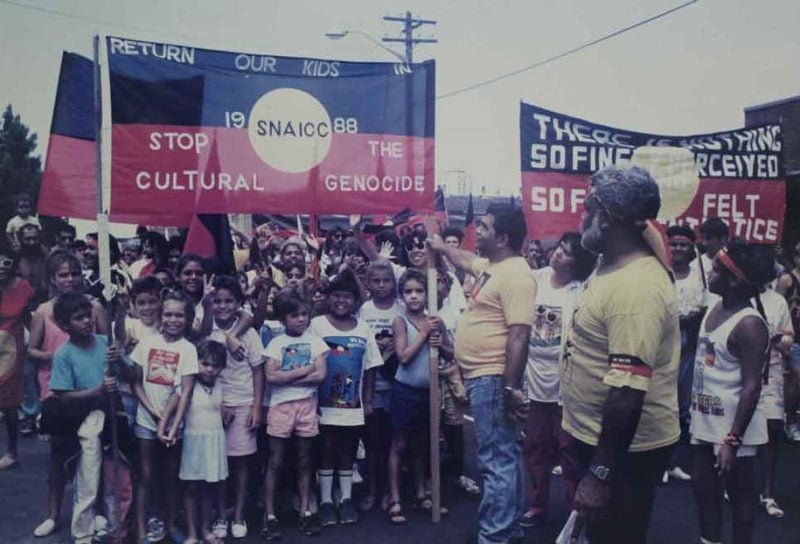
SNAICC continued to grow as a national voice for Aboriginal and Torres Strait Islander children and families throughout the 1980s, advocating for community control, participation in child protection decisions and culturally appropriate policy and practice. A key milestone was the establishment of National Aboriginal and Torres Strait Islander Children’s Day in 1988, which is still celebrated each year on 4 August. Initiated by SNAICC during the Australian Bicentenary year, Children’s Day was created as both a celebration of Aboriginal and Torres Strait Islander children and an assertion of survival, cultural strength and self-determination at a time when many Aboriginal and Torres Strait Islander peoples were challenging national narratives that overlooked the impacts of invasion and colonisation.
1990s
In 1990, SNAICC, in partnership with the Brotherhood of St Laurence, released Aboriginal Child Poverty: Our Children are Our Future, a report that highlighted the links between child poverty, child abuse and neglect and drew national attention to the structural disadvantage experienced by Aboriginal and Torres Strait Islander children and families. That same year, SNAICC began calling for a national inquiry into the policies and practices that had led to the removal of Aboriginal and Torres Strait Islander children from their families. In 1991, SNAICC became one of the first national Aboriginal and Torres Strait Islander organisations to formally call for an inquiry into what became known as the Stolen Generations.
Following a national conference on domestic violence convened by SNAICC in Canberra in 1989, SNAICC also led one of the first national Aboriginal and Torres Strait Islander family violence awareness campaigns. In 1991–92, SNAICC produced Through Black Eyes: Family Violence Resource Handbook, a resource developed to support families and communities to identify, prevent and respond to family violence and child abuse. The campaign promoted the messages ‘Domestic Violence – Not Our Way’ and ‘Child Sexual Abuse – Not Our Way’ and emphasised community responsibility and culturally grounded responses to violence.
In 1993, SNAICC released Aboriginal Child Welfare: Framework for a National Policy, which called for national legislation and policy to support the Child Placement Principle and strengthen culturally appropriate child protection responses. This advocacy contributed to the Australian Government establishing the National Inquiry into the Separation of Aboriginal and Torres Strait Islander Children from Their Families in 1995, conducted by the Human Rights and Equal Opportunity Commission. The Inquiry’s report, Bringing Them Home, was released in 1997 and contained 54 recommendations. It became a watershed moment in public and political understanding of the Stolen Generations and the ongoing impacts of child removal policies. Following the report’s release, SNAICC continued advocating for governments to implement its recommendations and address the ongoing over-representation of Aboriginal and Torres Strait Islander children in child protection systems.
In 1996, SNAICC developed the Proposed Plan of Action for Prevention of Child Abuse and Neglect in Aboriginal Communities, advocating for prevention, early intervention and community-led responses to child abuse and neglect. Additionally, at the 1997 National Aboriginal and Torres Strait Islander Child Survival Conference in Naarm/Melbourne, SNAICC urged all states and territories to adopt and properly implement the Child Placement Principle, so that Aboriginal and Torres Strait Islander children in out-of-home care remain connected to family, community and culture. The Child Placement Principle continues to underpin culturally safe child welfare practice today.
By the late 1990s, SNAICC’s membership had expanded to include early childhood services such as Multifunctional Aboriginal Children’s Services (MACS), strengthening our ability to support community-controlled services and advocate across both child protection and early childhood sectors. This broader membership base enhanced SNAICC’s capacity to provide practical support, resources and policy advocacy and formed the foundation of SNAICC’s role as a national advocate across the full continuum of early childhood development and child and family wellbeing systems.
2000s
In 2000, SNAICC prepared a national overview report on the operation of the 37 Commonwealth-funded Multifunctional Aboriginal Children’s Services (MACS) for the Department of Family and Community Services. The report clarified the roles and functions of MACS services and contributed to a stronger national understanding of the Aboriginal and Torres Strait Islander early childhood sector. We also strengthened our international advocacy during this period, representing the rights and needs of Aboriginal and Torres Strait Islander children at the United Nations Working Group on Indigenous Populations in 1998 and 2000. This work helped bring Aboriginal and Torres Strait Islander perspectives into global discussions on First Nations’ children’s rights.
In 2001, SNAICC published Through Young Black Eyes, alongside a Community Elders Guide, providing communities with culturally informed resources to prevent and respond to family violence, child abuse and neglect. The resource was later updated and republished to reflect evolving community priorities and practice approaches and remained an important tool for services and communities across Australia. Additionally, in 2002–03, SNAICC produced State of Denial: The Neglect and Abuse of Indigenous Children in the Northern Territory, which highlighted serious child welfare concerns in the Northern Territory and contributed to national debate about the need for culturally safe, community-led responses and stronger investment in Aboriginal and Torres Strait Islander children and families.
In 2003, SNAICC continued to influence national policy through initiatives such as the Our Future Generations: National Indigenous Child Welfare and Development Seminar, held to mark SNAICC’s 20th anniversary. Further, a major milestone came in 2004 with the establishment of the SNAICC Resource Service, funded by the Australian Government to develop and share culturally informed resources for services working across early childhood, family support and child protection. During this period, SNAICC also produced practical sector resources including Footprints to Where We Are: A Resource Manual for Aboriginal and Torres Strait Islander Children’s Services, supporting services to strengthen governance, cultural practice and service delivery.
In 2006, SNAICC secured agreement with the Australian Government to develop the National Indigenous Child Care Plan, intended to guide the future development of Aboriginal and Torres Strait Islander child care services and strengthen the sector’s capacity. The Plan represented an important step towards a coordinated national approach to Aboriginal and Torres Strait Islander early childhood policy and service development. By SNAICC’s 25th anniversary in 2008, the SNAICC Resource Service had become an important national source of practical, culturally informed information, publications and support for services working with Aboriginal and Torres Strait Islander children and families. Additionally, in the 2009 Federal Budget, the Australian Government announced funding for 35 Aboriginal and Torres Strait Islander Child and Family Centres, an initiative SNAICC had long advocated for to support integrated, culturally strong early years and family services.
2010s
In 2010, SNAICC played a central role in shaping the National Standards for Out-of-Home Care, which were later endorsed nationally in 2011. The standards helped establish benchmarks for more consistent, culturally safe care and stronger involvement of Aboriginal and Torres Strait Islander communities in decisions affecting children in state care systems. During this period, SNAICC’s international profile continued to grow, with participation in United Nations forums in New York and Geneva bringing Aboriginal and Torres Strait Islander perspectives on children’s rights to global discussions.
The decade also saw the development of significant resources and initiatives, including Journey to Big School, a community-based model supporting culturally responsive transitions to school for Aboriginal and Torres Strait Islander children, and Whose Voice Counts?, which provided a framework for strengthening Aboriginal and Torres Strait Islander participation in child protection decision-making. Additionally, through the Kids Matter: Early Childhood initiative, SNAICC produced culturally informed resources and training modules to support Aboriginal and Torres Strait Islander children’s social and emotional wellbeing. SNAICC also developed models for cultural advice and support within child protection systems, strengthening implementation of the Child Placement Principle and improving culturally informed decision-making.
Expansion of the SNAICC Resource Service, national directories and targeted early years initiatives provided practitioners with tools, training and culturally grounded guidance and, additionally, in 2013, SNAICC celebrated the 25th anniversary of Children’s Day. During the 2010s, SNAICC coordinated events including Our Future Generations seminars, contributed major submissions including to the Senate Inquiry into Out-of-Home Care and developed Moving to Prevention, a framework promoting prevention, early intervention and family-strengthening approaches across child and family wellbeing systems.
A defining milestone came in 2014 with the establishment of Family Matters, the first national publication dedicated to holding governments to account and eliminating the over-representation of Aboriginal and Torres Strait Islander children in out-of-home care within a generation. The Family Matters publication has become a cornerstone of SNAICC’s advocacy, documenting systemic inequities, sharing community-led solutions and advocating for culturally safe, preventative and family-strengthening approaches across child protection, early years and family support systems.
In 2016, SNAICC undertook a major organisational transformation, incorporating under the CATSI Act and refreshing its name to SNAICC – National Voice for our Children. Incorporation was accompanied by governance and membership reforms designed to strengthen representation and position SNAICC for future growth as the national peak body for Aboriginal and Torres Strait Islander children. The 7th SNAICC National Conference in 2017, themed Bring Them Home: Securing the Rights of Our Children, brought together more than 1,100 delegates from across Australia and reinforced SNAICC’s role as the leading national forum for Aboriginal and Torres Strait Islander child and family wellbeing.
In 2018, SNAICC played a key role in the Closing the Gap Refresh, advocating for new targets, stronger accountability and increased investment in early years services. As a founding member of the Coalition of Peaks, SNAICC helped establish stronger shared decision-making principles between Aboriginal and Torres Strait Islander peak bodies and governments and contributed to shaping the national partnership approach to Closing the Gap. Throughout this work, SNAICC continued to champion implementation of the Child Placement Principle and greater investment in community-controlled solutions. The decade closed with the 8th SNAICC National Conference in 2019, which set a new record with 1,230 delegates and reinforced the importance of Aboriginal and Torres Strait Islander leadership in shaping the future for children and families.
2020s
Throughout the 2020s, SNAICC has continued to strengthen our national leadership, driving policy, sector and community reform to protect the rights, safety and wellbeing of Aboriginal and Torres Strait Islander children, young people and families. The decade began with the signing of the National Agreement on Closing the Gap in 2020. As a founding member of the Coalition of Peaks and a signatory to the National Agreement, SNAICC has played a central role in advancing the Priority Reforms, including strengthening shared decision-making, growing the Aboriginal and Torres Strait Islander community-controlled sector and improving government accountability to Aboriginal and Torres Strait Islander peoples and communities.
Building on decades of advocacy, SNAICC has played a leading role in shaping major national frameworks, including co-leading development of the National Aboriginal and Torres Strait Islander Early Childhood Strategy in partnership with the National Indigenous Australians Agency. The Strategy became one of the first major national policies developed under the shared decision-making principles of the National Agreement on Closing the Gap. SNAICC has also been instrumental in shaping Safe and Supported: the National Framework for Protecting Australia’s Children 2021–31. Developed through extensive consultation and collaboration, the framework embeds Aboriginal and Torres Strait Islander leadership and shared decision-making within national approaches to reducing child abuse and neglect.
SNAICC’s community-focused work has continued through regular engagement with Aboriginal and Torres Strait Islander community-controlled organisations and services across Australia, strengthening understanding of sector challenges and ensuring community voices inform national policy discussions. The decade saw the establishment of innovative programs such as the THRYVE Pilot Program, now known as Early Years Support, launched in 2021 to strengthen culturally strong early childhood development services across jurisdictions. Early Years Support has achieved significant milestones, including the establishment of statewide intermediary organisations in New South Wales, Western Australia and Victoria, with governance co-designed with Aboriginal and Torres Strait Islander stakeholders to ensure culturally responsive and accessible support for families.
SNAICC has also expanded its practical support for early childhood development through initiatives including Connected Beginnings, First Nations Playgroups and multidisciplinary early years programs that strengthen community-controlled service delivery and improve access for children and families. From 2022 onwards, SNAICC continued supporting sector development through national gatherings, conferences, community forums and collaborative policy work. This included contributing to the Early Childhood Care and Development Sector Strengthening Plan and supporting the co-design of Wakwakurna Kanyini – For Aboriginal Children and Families, a new peak body for Aboriginal children and families in South Australia.
Significant advocacy achievements continued into 2023 and 2024, culminating in the Australian Government’s commitment to establish a National Commissioner for Aboriginal and Torres Strait Islander Children and Young People, a longstanding goal of SNAICC and the broader sector. The commitment was announced in 2024, with Lil Gordon appointed in an acting capacity in early 2025 and Adjunct Professor Sue Anne Hunter later appointed as the first permanent National Commissioner. The establishment of the Commissioner created an important new national accountability mechanism to advocate for the rights, wellbeing and interests of Aboriginal and Torres Strait Islander children and young people.
In 2025, SNAICC expanded its national partnerships through formal agreements with the Department of Education and the National Aboriginal and Torres Strait Islander Education Corporation to improve education outcomes from early childhood through to higher education in culturally responsive ways. During this period, SNAICC also led consultations for the development of Australia’s first National Aboriginal and Torres Strait Islander Family Safety Plan, supporting community-led responses to family violence and child safety and ensuring Aboriginal and Torres Strait Islander voices shaped national reform efforts. SNAICC also established Youth Voice, including a Youth Advisory Group, to ensure Aboriginal and Torres Strait Islander young people directly shape policy and advocacy work. This initiative embeds youth perspectives across SNAICC’s governance and national priorities and strengthens its commitment to empowering the next generation.
Across more than four decades, SNAICC’s work has continued to influence national policy, strengthen the Aboriginal and Torres Strait Islander community-controlled sector and ensure Aboriginal and Torres Strait Islander voices remain central in decisions affecting children, young people and families. Guided by community leadership, SNAICC continues working towards a future where every Aboriginal and Torres Strait Islander child grows up safe, strong in culture, connected to family and empowered to reach their full potential.
Join Us
Be part of our advocacy efforts and stay informed about our initiatives.
Become a member today and add your voice to the cause.